Two palaces in one
Holyrood has layers, and seeing them helps the visit make sense. The oldest standing part is the north-west tower, begun by James V in 1528. Mary, Queen of Scots lived in its second-floor suite from 1561 to 1567.
Most of the rest is later. Charles II had the palace rebuilt around a courtyard between 1671 and 1678, to a design by Sir William Bruce, and kept James V’s tower as one corner. The state rooms you walk through date from that rebuild.
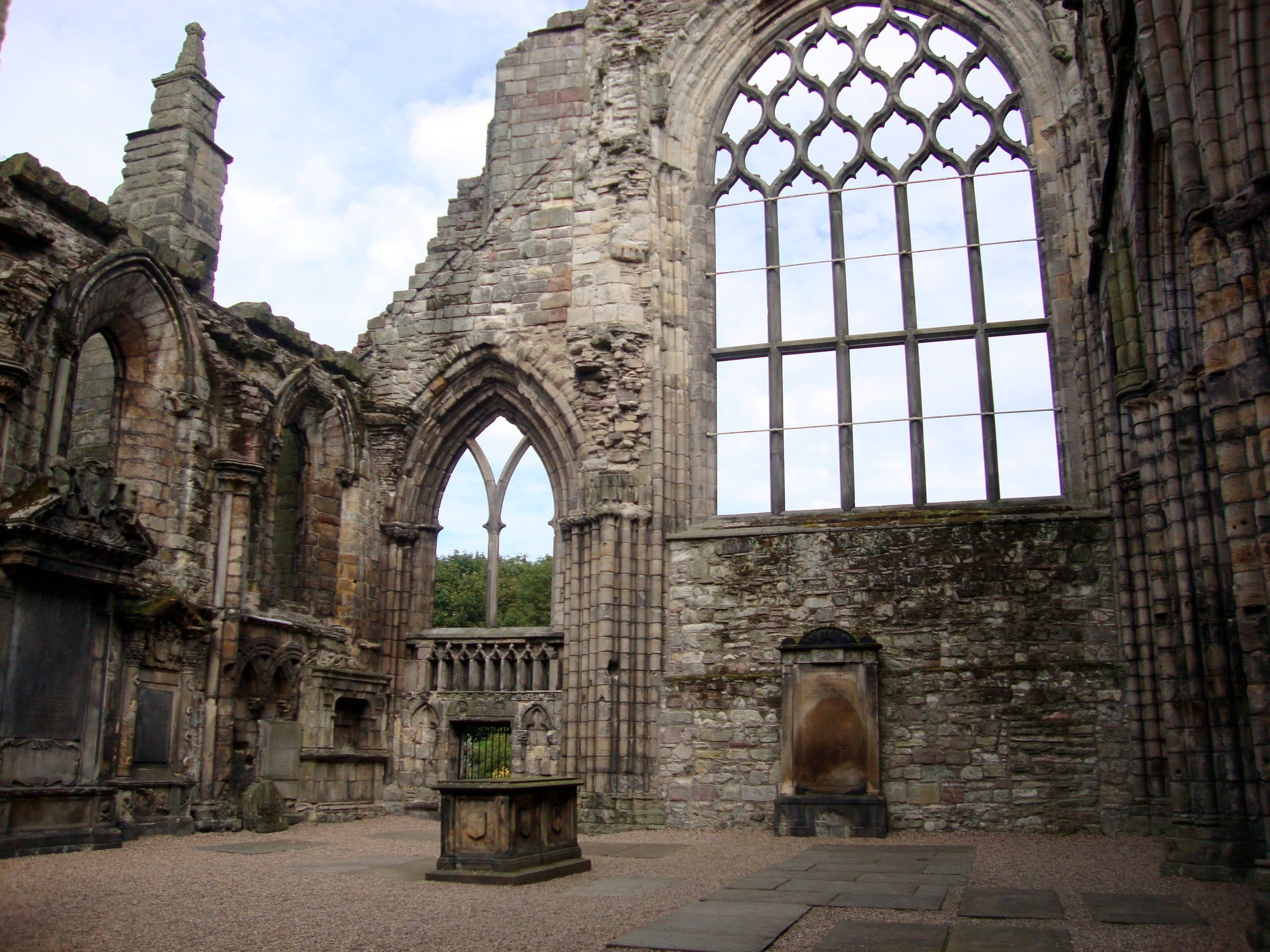
Next door are the ruins of Holyrood Abbey, which David I founded in 1128. The abbey came first. James IV built a Gothic palace beside it between 1501 and 1505, and the Stuart court used the site for generations.
One standard ticket covers the palace, abbey and gardens, and the free multimedia guide leads you through the rooms. For prices and booking, see tickets and tours.
The Great Stair and State Apartments
The Great Stair is the stone staircase Charles II had built, with an angel on the ceiling holding the crown of Scotland. It leads into the State Apartments, which the monarch and the royal family use for ceremonies and official events.
That is the odd double life of Holyrood. It is a visitor attraction for most of the year, and a working palace when the King is in Scotland: royal.uk says the monarch hosts thousands of guests here during Holyrood Week.
The Royal Dining Room is one stop. It was redecorated for George V and Queen Mary, and Elizabeth II used it. Look out for the unicorns, Scotland’s national animal, which appear on gateposts, walls and ceilings around the palace.
A palace that is still in use
Holyrood is not a museum that happens to be a palace. It is the monarch’s official residence in Scotland, and the rooms you pass through are working spaces. Wikipedia notes that King Charles III receives the First Minister and the Presiding Officer of the Scottish Parliament in the Morning Drawing Room, for example.
A second tenant arrives each year. Since 1834 the Lord High Commissioner to the General Assembly of the Church of Scotland has stayed in the palace for the week the Assembly meets. This is one reason the timetable has gaps, which visiting Holyrood explains.
The multimedia guide
The multimedia guide included with your ticket takes about an hour and runs in ten languages. It also comes in British Sign Language and with subtitles, and an audio-described version is available for blind and partially sighted visitors. A free family version and a Family Room with dressing-up and hands-on objects are aimed at children.
Because the guide sets the pace, you can skip rooms or linger as you like. If you would rather have a person, the Trust runs an Exclusive Guided Tour of the State Apartments for small groups when the palace is closed to other visitors. Tickets and tours has the details.
The Throne Room
The Throne Room has had three jobs. It began as the King’s Guard Chamber, became the King’s Drawing Room after George IV’s visit in 1822, and took its present name in 1871. It is an oak-panelled room with a portrait of Charles II by John Michael Wright.
Its recent history is the part that stays with people. The coffin of Queen Elizabeth II lay in repose here on 11 and 12 September 2022. There are benches in the room, which makes it a good place to rest.
The Great Gallery
The Great Gallery is the palace’s largest room, about 45 metres long. Its walls carry portraits of Scottish monarchs, which Charles II commissioned from the painter Jacob de Wet. They were finished between 1684 and 1686.
Bonnie Prince Charlie held balls here in 1745, while he occupied the palace.
Mary, Queen of Scots’ chambers
This is the part most visitors come for, and it is on the older side of the palace. The Trust says access to these rooms is restricted, so check its access information if stairs are a problem.
Mary received visitors and held her audiences with the reformer John Knox in the Outer Chamber. It is also where her private secretary, David Rizzio, was killed on 9 March 1566. Tradition says he suffered 57 dagger wounds, and an alleged bloodstain is still pointed out. Treat the stain as folklore.
The Darnley Jewel is the other object the Trust highlights. It is a heart-shaped locket of blue glass, rubies and an emerald, linked to Mary. Check on the day whether it is on display, as objects rotate.
The tower is the oldest part of the palace, so these rooms show Holyrood before Charles II’s rebuilding.
Holyrood Abbey ruins
David I founded the abbey in 1128. Legend says he did so in thanks after a close escape from a stag while hunting.
Time was unkind to the abbey. The choir and transepts were pulled down in 1570, and the nave served as a parish church. Stone vaults added in the 1750s proved too heavy, and the roof collapsed on 2 December 1768. What survives is a roofless nave open to the sky.
The Royal Vault holds the remains of several Scottish kings, including James V. Standing in the nave, with the palace beside you, shows how closely the two were linked.
A note on closures: the Trust lists the abbey ruins as part of the visit, but some ticket resellers reported in 2026 that the abbey and gardens were closed for conservation work. We could not confirm that on a Trust page, so check the visitor page before you go.
The gardens
The gardens cover about 4 hectares, or 10 acres, and the Trust says they are open to ticket holders daily, weather permitting. The highlights it names include the Jubilee Border, the Wentworth Elm and a sundial made for Charles I’s Scottish coronation in 1633.
They also host the palace’s events. The Ceremony of the Keys, a garden party and the Royal Company of Archers’ Reddendo Parade all take place in the grounds during Holyrood Week, according to royal.uk.
A separate community garden on Abbey Strand is free to enter whenever the palace is open.
The King’s Gallery
The King’s Gallery, once called the Queen’s Gallery, is the exhibition space beside the palace entrance. It has its own ticket, and the current exhibition, The Edwardians: Age of Elegance, runs until 6 December 2026 (checked October 2026). The Trust offers 10% off both tickets if you book the palace and gallery together.
How long each part takes
The Trust says the multimedia guide lasts about an hour, and that sets the baseline. These are our own rough allowances on top, not official figures:
- State Apartments and Mary’s chambers: an hour with the guide, longer if you stop in each room.
- Abbey ruins: 15 to 20 minutes.
- Gardens: 20 to 30 minutes, more on a dry day.
- King’s Gallery: 30 to 45 minutes.
- Café: 20 minutes. See visiting Holyrood for the practical details.
If you are short of time, prioritise the Great Gallery and Mary’s chambers, then the abbey. Skip the gardens in the rain. For a wider plan that includes the street outside, see the Royal Mile and Arthur’s Seat guides.